The Philosophy and Spiritual Significance of Lord Ardhanarishvara
Introduction to Lord Ardhanarishvara
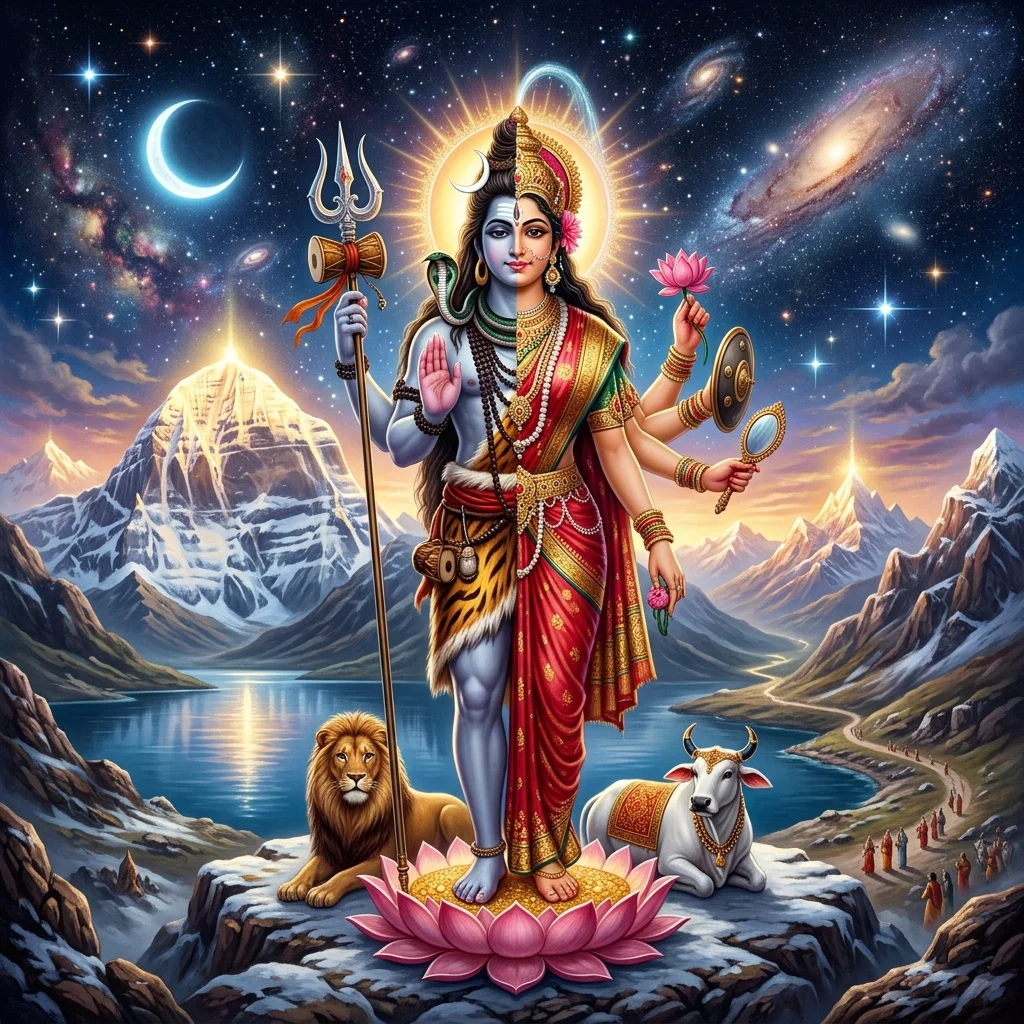
In the vast expanse of Hindu philosophy and iconography, the representation of the divine takes many beautiful forms. Among these, the composite form of Lord Ardhanarishvara (the half-male, half-female deity) stands out as a supreme symbol of cosmic unity. Depicting Lord Shiva on the right and Goddess Parvati (Shakti) on the left, split equally down the middle, it illustrates that the ultimate reality is non-dual, embracing both masculine and feminine principles. Worshipping this form teaches us that gender is a physical attribute, but the soul is beyond gender, embodying both qualities in perfect harmony. In our Spiritual Articles directory, we discuss various forms of devotion, but the Ardhanarishvara philosophy is perhaps the most profound representation of cosmic balance. In this article, we will delve into the mythological origins, spiritual concepts, and the immense benefits of worshipping Lord Ardhanarishvara.
The Legend of Sage Bhringi: The Mythological Origin
The origin of the Ardhanarishvara form is associated with a fascinating legend in the Shiva Purana. Sage Bhringi was an ardent devotee of Lord Shiva. However, he had a stubborn vow that he would only worship the masculine aspect (Shiva) and entirely ignore the feminine aspect (Shakti). One day, when he visited Mount Kailash, Lord Shiva and Goddess Parvati were sitting closely together. Bhringi attempted to circumambulate Shiva alone, bypassing Parvati.
To show the sage that Shiva and Shakti are inseparable, the divine couple merged their bodies into one single form—Ardhanarishvara. Undeterred, Bhringi assumed the form of a small beetle (Bhringa), bored a hole through the center of their combined body, and flew only around the right side representing Shiva.
Goddess Parvati, amused yet wishing to teach the sage a lesson, declared that if he felt the feminine principle was useless, he should lose all bodily parts derived from the mother. According to ancient physiology, bones and nerves come from the father (masculine), while flesh, blood, and skin come from the mother (feminine). Instantly, Bhringi lost his flesh and blood, collapsing as a mere skeleton. Recognizing his error and the truth that Shiva cannot exist without Shakti, he begged for forgiveness. Lord Shiva, moved by his devotion, granted him a third leg to stand. This story marks the origin of the Ardhanarishvara form, symbolizing that the universe requires both elements to exist and function.
Purusha and Prakriti: The Cosmic Philosophy
The Ardhanarishvara concept is closely aligned with the Samkhya school of Hindu philosophy, which states that creation is a result of the union between two principles:
- Purusha (Shiva - Pure Consciousness): The static, unmanifest, silent witness consciousness.
- Prakriti (Shakti - Creative Energy): The dynamic, active, manifest creative force of nature.
Without Purusha, Prakriti has no direction or consciousness. Without Prakriti, Purusha remains unexpressed and silent. They are as inseparable as fire and its heat, or a word and its meaning. Adi Shankaracharya famously opens his Saundarya Lahari by stating, "Only when Shiva is united with Shakti does he acquire the power to create; otherwise, he cannot even move." This highlights the equal importance of both energies in the cosmos.
Family Harmony and Marital Equality
At a societal and personal level, Ardhanarishvara serves as a powerful reminder of gender equality and marital harmony. It teaches that husband and wife are equal partners in life, two halves of a whole. Cultivating mutual respect, empathy, and letting go of ego leads to a peaceful family life. Worshipping Ardhanarishvara, especially on auspicious nights like Pournami or during twilight worship like Pradosham, helps resolve disputes between couples and brings peace to the household.
Astrological Relief and Mental Balance
In astrology, Lord Shiva represents the Sun (representing soul, father, authority), while Goddess Parvati represents the Moon (representing mind, mother, emotions). Worshipping Lord Ardhanarishvara helps pacify afflictions related to both the Sun and the Moon in one's horoscope. It also mitigates Mars-Venus doshas, which often cause delays in marriages. For daily timing details and tithi rules, you can refer to our Daily Panchangam guide. Furthermore, on a psychological level, it helps balance the left brain (logical, analytical) and right brain (creative, emotional), bringing absolute mental peace.
Worship Methods and Festivals
The best times to offer prayers to Lord Ardhanarishvara are during the evening twilight hours of Pradosham and on the holy night of Maha Shivaratri. Chanting the Ardhanarishvara Stotram composed by Adi Shankaracharya is highly meritorious. The temple of Tiruchengode in Tamil Nadu is one of the most famous shrines where the deity is worshipped as a self-manifested (Swayambu) Ardhanarishvara. Worshipping here or lighting a ghee lamp before his image at home invites prosperity and good health.
Conclusion
Lord Ardhanarishvara represents the ultimate truth of balance—that the masculine and feminine, spirit and matter, logic and emotion must exist in perfect equilibrium. By embracing this philosophy, we can bring harmony to our relationships, peace to our minds, and spiritual progress to our lives.